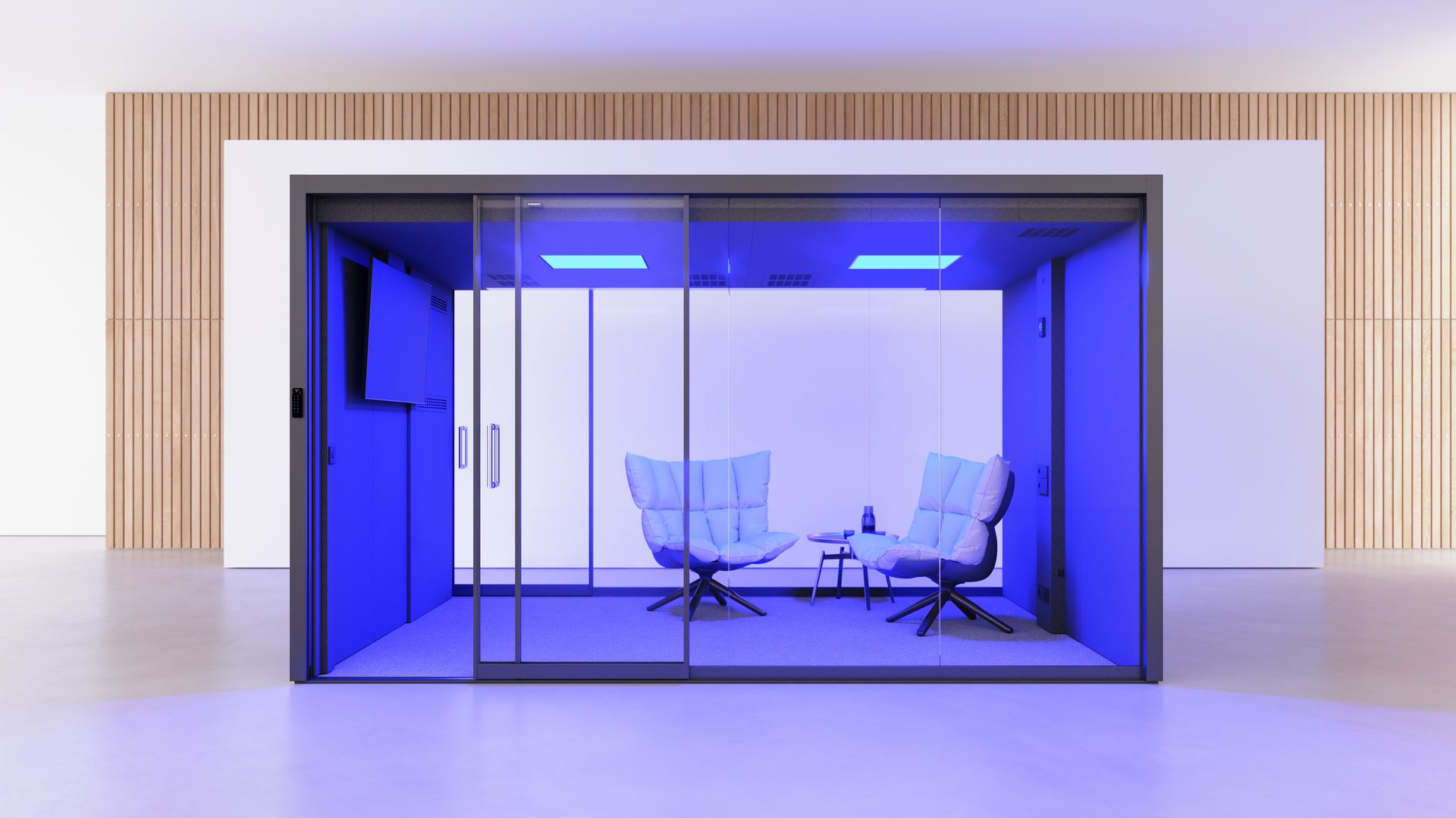
Photon Disinfection is an effective means to destroy bacteria and fungi automatically. When utilized with a photocatalytic coating (Ti02), it also destroys viruses, VOCs, and odors. Unlike Ultra Violet lighting, Vetrospace’s technology is completely safe for humans and other materials. The light is non-ionizing and has been tested by the Radiation and Nuclear Safety Authority of Finland (STUK).
Our lighting has two functions: the blue light (WiSDOM AiR) is activated when the space is unoccupied, while the white light (ANTiBAC) is activated when someone enters the space. ANTiBAC looks like a normal light, but contains proportionally more blue light than general white lighting. This light offers productivity-enhancing properties similar to daylight.
Bluelight Disinfection’s Antimicrobic Effect
At the beginning of March, M.D Leena Rahkonen asked staff at the maternity hospital about areas that are in need of The ability of blue light to destroy microbes is based on its ability to energize naturally light-sensitive compounds inside the micro-organism so that they start producing reactive oxygen radicals. Reactive oxygen species (ROS) are molecules containing very reactive oxygen, causing damage to the microbe and destroys it internally.
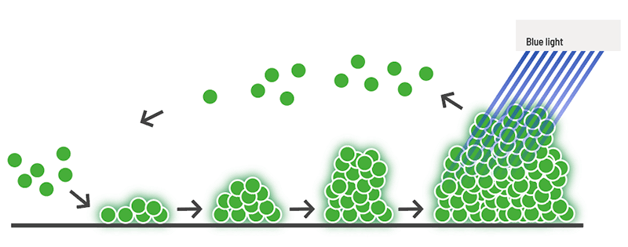
Biofilm
Research evidence shows that blue light is very effective even on microbes inside biofilm, unlike common biocides.
-
Airborne bacteria attach to the surface.
-
Bacteria starts to grow and divide, forming a dense cellular layer.
-
While growing, the bacteria produce mucus and extracellular substances that form an outer protective nourishing layer.
-
The bacteria continue to grow and divide, protected by the film.
-
If the biofilm breaks, bacteria are released from the protective matrix and can spread to new surfaces, where they attach and begin forming new biofilms, repeating the cycle.
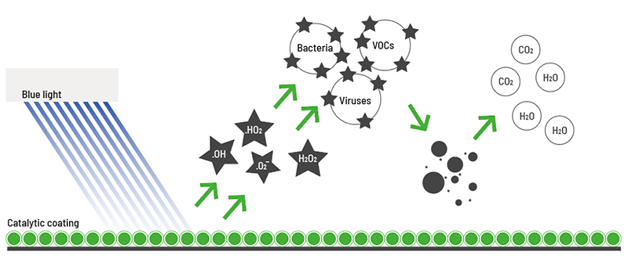
Photocatalytic Reaction of the Catalytic Coating
-
The coating is activated by light with suitable wavelength and intensity.
-
The activated coating produces reactive oxygen species, ROS. (superoxide radicals (•O₂-), hydroperoxide radicals (•HO₂), hydroxyl radicals (•OH) ja H₂O₂)
-
The ROS are extremely short-lived, reacting with the microbes and VOCs on the surface.
-
Microbes and VOCs disintegrate, and ROS are neutralized into water and carbon dioxide.
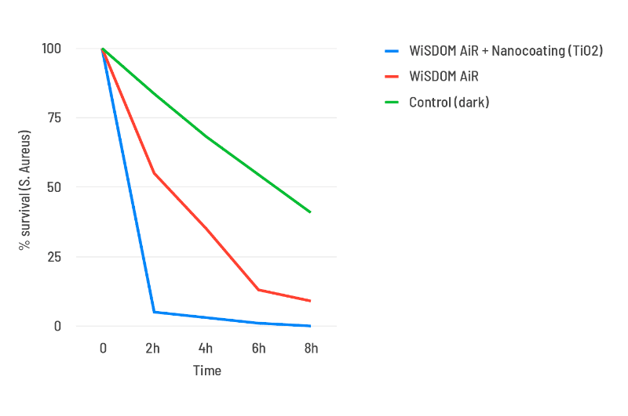
The Antimicrobic Effect of ANTiBAC and WiSDOM AiR Luminaires with the Catalytic Coating
In spring 2019, laboratory tests were conducted at the FINAS accredited Metropolilab to determine the efficiency of our photon disinfection luminaires in the inactivation of Staphylococcus aureus (ATCC 6538) with the catalytic coating. The bacteria were plated on a regular melamine table top and irradiated at low intensity (blue light 0,7 mW/cm² and white light 500 lux). The results were confirmed by conducting three separate tests, with each test utilizing three parallel samples from each point of analysis. Six hour irradiation resulted in reduction of up to > 99,9 %. In our GROUPSPACE pods the bluelight intensity is about 2,5mW/cm² ja white light intensity about 1200 lux.
Benefits of photon disinfection
Always working in the background
Unlike manual cleaning, photon disinfection doesn’t rely on schedules or human consistency. It operates continuously, reducing microbial buildup throughout the day and night—even between cleanings.
Chemical-free and environmentally friendly
No disinfectants, no residues, and no harmful byproducts. The process uses light and naturally occurring reactions, making it a cleaner option for both people and the environment.
Safe for everyday human exposure
Because the light is non-ionizing (unlike UV-C), it can be used in occupied spaces without posing risks to people, materials, or sensitive equipment. It integrates seamlessly into normal lighting conditions.
Reduces a broad range of contaminants
Photon disinfection doesn’t just target bacteria—it can also help break down viruses, fungi, odors, and volatile organic compounds (VOCs), especially when combined with a photocatalytic coating.
Effective against biofilms
Many traditional disinfectants struggle to penetrate biofilms (protective layers formed by microbes). Photon disinfection can disrupt and reduce these resilient microbial communities more effectively.
Consistent and reliable performance
It delivers stable antimicrobial activity over time, without the variability that comes from manual cleaning methods or improper chemical use.
Low maintenance, long lifespan
With lifetimes exceeding 50,000 hours (roughly a decade of typical use), the system requires minimal upkeep and incurs virtually no ongoing operating costs.
No risk of antimicrobial resistance
Because it destroys microbes through oxidative stress rather than chemical pathways, it does not contribute to the growing problem of resistant strains.
Improves indoor air and surface quality simultaneously
By reducing airborne microbes and breaking down pollutants, it supports healthier indoor environments—not just cleaner surfaces.